
Why Holiday Parks Need a Different Approach to Tree Risk Management
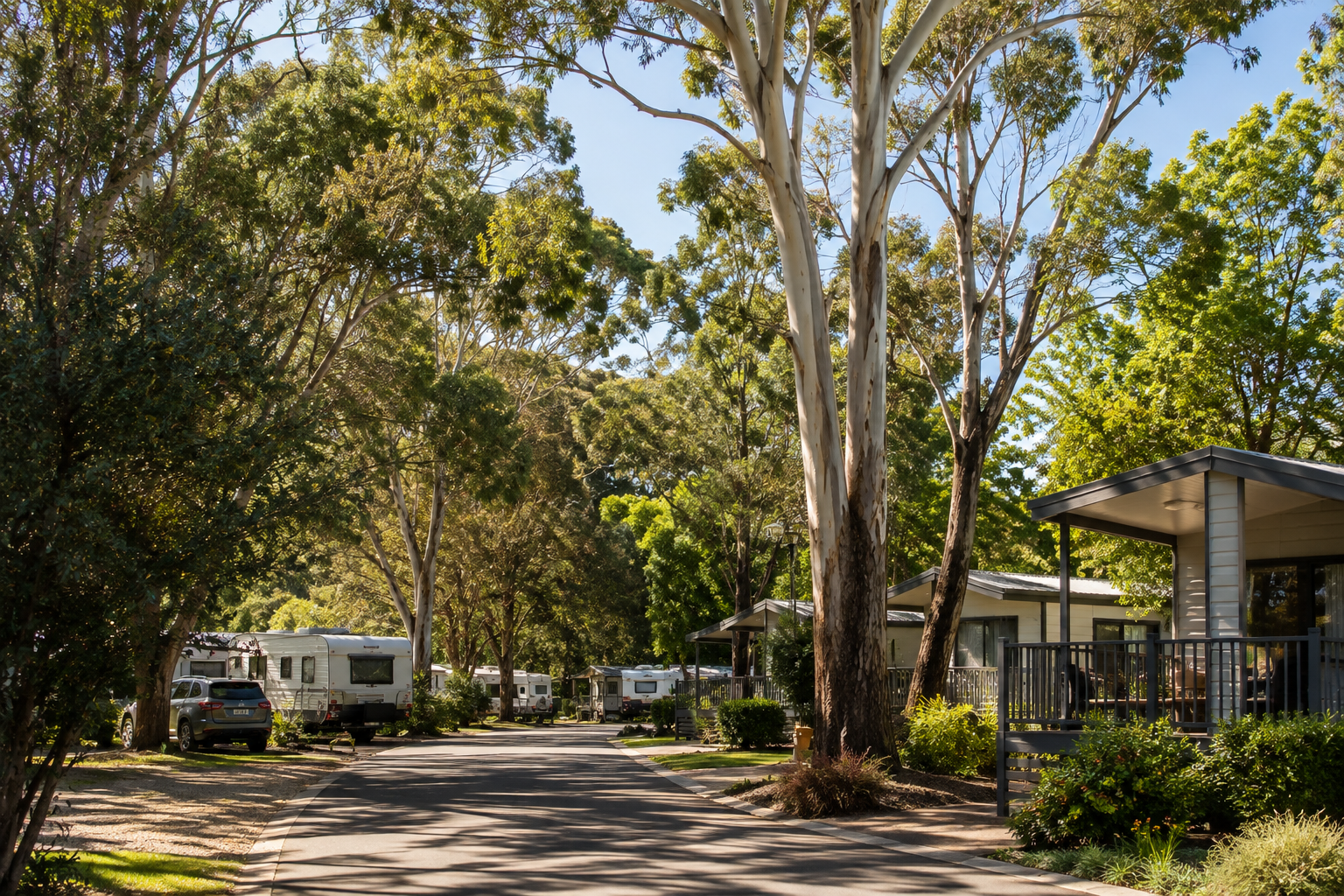
Trees are a major part of the holiday park experience. They provide shade, privacy, character and a connection to the natural environment that guests value.
They can also create complex management challenges.
In a holiday park, trees are positioned around cabins, campsites, roads, playgrounds, pools and shared facilities. The site is constantly changing, guest movement can be difficult to predict, and occupancy often peaks during periods of heightened weather risk.
This means tree risk cannot be managed in the same way as it would be across a typical commercial property.
Holiday Park operators need an approach that protects guests and assets, supports day-to-day operations and preserves the natural environment that makes the park appealing.
Guests use park spaces differently
Holiday parks are active and constantly changing environments.
Guests may park beneath trees, move outdoor furniture, place tents outside designated areas or allow children to play in spaces that are not normally occupied.
Unlike staff or long-term residents, they may also be unfamiliar with the park and less likely to recognise signs of tree damage or instability.
This makes it important to assess tree risk based not only on the condition of the tree, but also on how people use the surrounding area.
This is where assessment by an AQF Level 5 consulting arborist becomes important. Tree risk should be considered not only in relation to the condition of the tree, but also how people use and move through the surrounding area.
A tree located beside a rarely used boundary may present a very different level of risk from the same tree positioned near a playground, cabin or high-traffic campsite.
Peak season is the worst time to discover a problem
Holiday parks often experience their highest occupancy during school holidays, long weekends and warmer months.
These periods can also coincide with storms, high winds, extreme heat and prolonged dry conditions.
Discovering a significant tree issue during peak season may result in:
Accommodation or campsites becoming unavailable
Guests needing to be relocated
Roads or facilities being temporarily closed
Emergency contractors working around visitors
Unplanned costs and operational disruption
Scheduling inspections and priority maintenance before busy periods gives park managers more control over timing, access and budgets.
It also reduces the likelihood of urgent works being required when the site is at its busiest.
Trees are closely connected to park assets
Within a holiday park, trees may be located near:
Cabins and permanent accommodation
Caravans, tents and camping areas
Playgrounds and swimming pools
Roads and pedestrian pathways
Powerlines and underground services
Reception buildings and shared amenities
Tree roots, branches and structural defects can affect these assets in different ways.
Construction and park upgrades can also affect nearby trees. Changes to soil levels, drainage, root zones or surrounding surfaces may influence tree health and stability over time.
Tree risk management should therefore form part of wider asset, maintenance and development planning—not sit separately as an occasional maintenance task.
An AQF Level 5 consulting arborist can assess how trees interact with surrounding infrastructure and identify where further investigation, monitoring or remedial works may be required.
The answer is not simply removing more trees
Mature trees are often among a holiday park’s most valuable natural assets.
They provide shade, improve amenity and contribute to the overall guest experience. Unnecessary tree removal can reduce the appeal of the park and create replacement costs that may take years to recover.
Effective risk management is about making informed decisions.
Depending on the tree and its location, recommendations may include:
Targeted pruning
Further investigation
Ongoing monitoring
Root-zone protection
Changes to how the surrounding area is used
Removal where risk cannot be appropriately managed
An AQF Level 5 consulting arborist can help operators balance safety and asset protection with the retention of healthy, valuable trees.
Multi-site operators need consistency
For groups managing several holiday parks, tree management can become inconsistent if each site uses different inspection methods, reporting formats or maintenance priorities.
A structured approach provides greater visibility across the portfolio.
This may include:
A consistent tree inventory
Clear risk ratings and priority actions
Photographic records
Recommended inspection intervals
Planned maintenance schedules
Records of completed works
Comparable reporting across multiple sites
This supports better decision-making at both park and leadership level.
It also makes it easier to identify recurring risks, plan budgets and demonstrate that tree-related responsibilities are being actively managed.
Good reporting turns an assessment into a plan
A tree inspection is only valuable when the findings are clear and practical.
Park managers need to know:
What requires immediate action
What should be planned and budgeted
What needs ongoing monitoring
When the next inspection should occur
How priorities may change over time
Clear reporting helps turn technical information into a manageable program of work.
It gives park managers practical next steps while providing owners and senior leaders with greater confidence that tree risks are being identified, prioritised and documented.
A proactive approach provides greater certainty
Unexpected tree issues cannot always be prevented, particularly following severe weather.
However, a proactive tree management program can significantly improve preparedness.
It allows holiday park operators to plan maintenance around quieter periods, protect important assets and make informed decisions about the trees across their sites.
Most importantly, it supports a safe and enjoyable environment for guests without compromising the natural features that make the park worth visiting.
Supporting holiday parks across Australia
Enviro Trees provides independent arboricultural consulting and managed tree services for holiday parks and multi-site operators across Australia.
Our AQF Level 5 consulting arborists deliver tree risk assessments, inspections, reporting and tree management recommendations, supported by Consulting Arboriculture Manager and AQF Level 8 Arborist Sam Munro for more complex arboricultural matters.
Sam will be attending the 2026 BIG4 National Conference & Exhibition at the National Wine Centre in Adelaide from 12–14 October 2026.
To arrange a conversation with Sam or discuss tree management across your park, contact Enviro Trees on 1300 077 233 or visit http://envirotrees.au/.