
What is involved in a tree risk assessment?
Managing trees across a commercial site, holiday park, school, council asset or large property portfolio is about more than responding when something goes wrong.
A structured tree risk assessment helps identify potential hazards, prioritise works and create a clear plan for ongoing tree management.
For sites with large numbers of trees, the assessment also creates a reliable record of tree condition, risk and recommended maintenance - helping property and facility managers make informed decisions over time.
What does a tree risk assessment include?
A typical tree risk assessment may involve the inspection of up to 100 trees using recognised assessment methods, including Quantified Tree Risk Assessment (QTRA).
All inspections and reporting are undertaken by an AQF Level 5 Arborist.
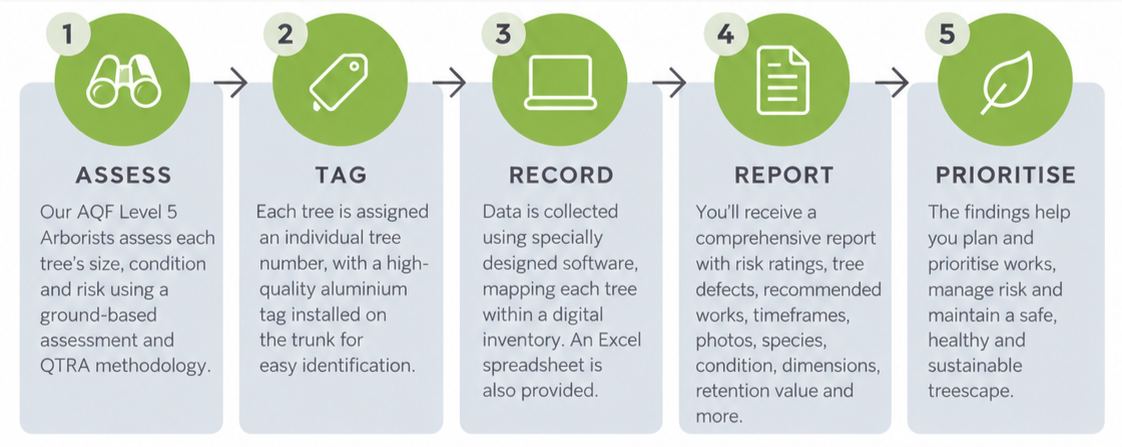
Each tree is assessed from the ground, with its size, condition and level of risk recorded.
Individual tree identification
Each tree is assigned an individual tree number and can be fitted with a high-quality aluminium tag for easy identification.
This provides a consistent reference point for future inspections, maintenance and reporting.
What information is recorded?
Following the assessment, a comprehensive report is provided outlining key information for each tree, including:
Risk rating
Tree defects
Recommended works, where required
Priority of works and recommended timeframes
Tree photograph
Species, including common and botanical name
Health and structural condition
Useful life expectancy
Age, height and trunk diameter
Origin
Tree significance
Arborist observations
This allows clients to clearly understand which trees require attention, what action is recommended and when works should be completed.
Digital tree management
Specially designed software is then used to collect and manage assessment data, mapping each tree to create a digital inventory of the site’s tree assets.
This information can be updated and filtered over time, helping clients quickly access specific tree data and monitor changes across the site. Clients can also be provided with access to the platform.
An Excel spreadsheet is then supplied alongside the report, containing the assessment data and a summary of recommended works and risk levels.
Understanding tree retention value
The STARS system can also be used to assess each tree’s retention value.
Developed by the Institute of Australian Consulting Arboriculturists, the system helps provide additional context when determining the significance and future management of individual trees.
More than a one-off assessment
A tree risk assessment is not simply about identifying hazardous trees.
It provides a practical framework for managing the entire treescape.
By identifying risks early, prioritising works and maintaining accurate records, organisations can better plan maintenance, allocate budgets and manage their duty of care across the site.
The result is a clearer, more proactive approach to tree management - helping maintain site safety while retaining healthy and valuable trees wherever possible.
Need a clearer picture of tree risk across your site?
Enviro Trees provides arborist consulting and tree risk assessment services for commercial properties, holiday parks, councils, facilities managers and other organisations across Australia.
Contact our team to discuss your site or learn more about our arborist consulting services.
Ph: 1300 077 233 or Email: info@envirotrees.au