
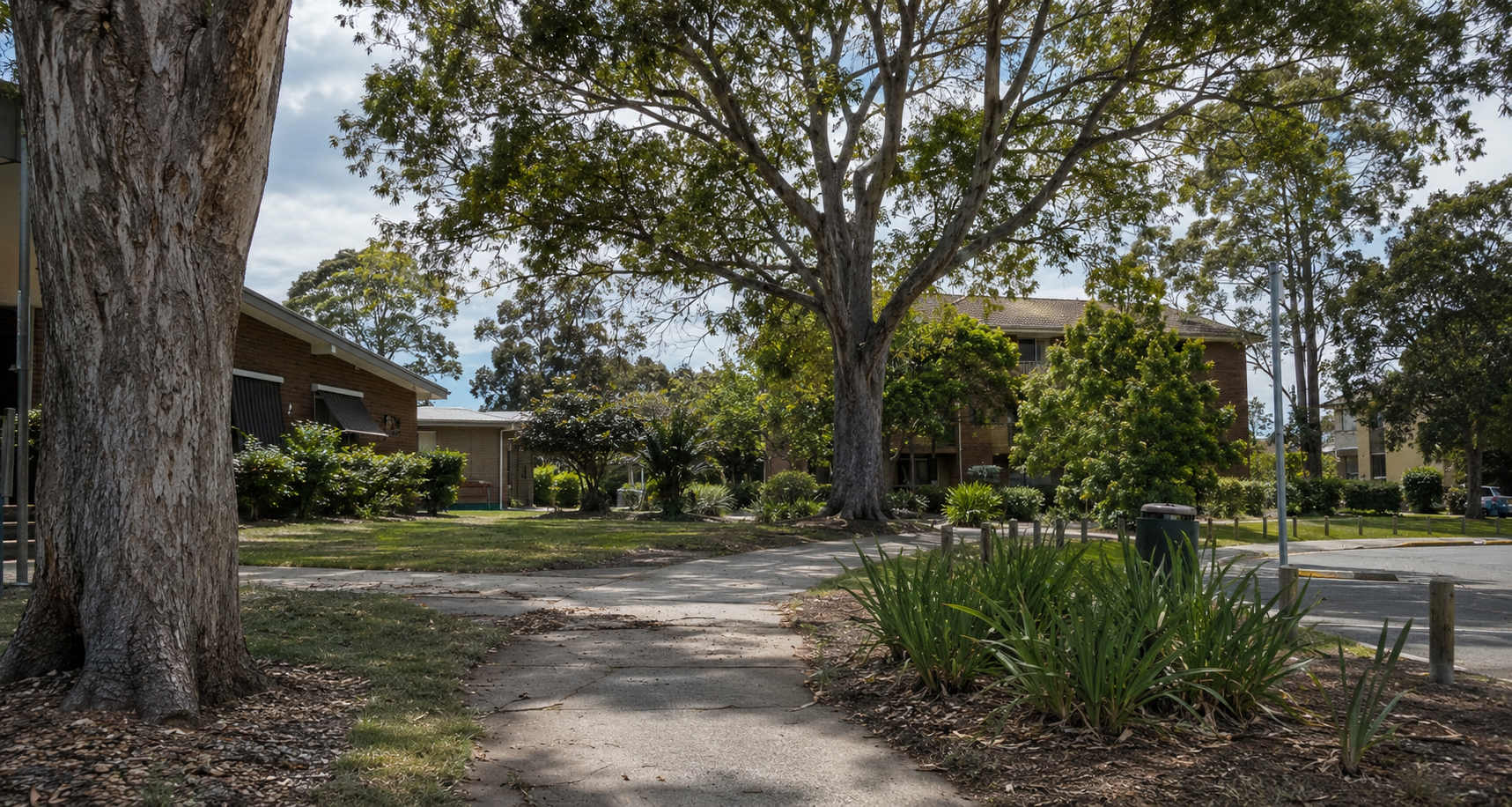
Trees play an important role in Australian communities. They provide shade, improve streetscapes, support biodiversity and make shared spaces more enjoyable for residents, visitors and the wider public.
But in communal areas and public spaces, tree safety cannot be left to chance.
Whether it is a school, strata complex, caravan park, council reserve, commercial property, public housing site or shared access area, trees need to be actively managed to reduce risk to people, property and surrounding infrastructure.
Why tree safety matters in shared spaces
Communal areas often have high foot traffic, parked vehicles, buildings, fences, playgrounds, pathways and public access points nearby. This means that if a tree or large limb fails, the impact can be serious.
Tree-related risks can increase after:
Severe storms or high winds
Extended wet weather
Drought or prolonged heat
Soil movement or erosion
Construction activity near root zones
Poor past pruning or unmanaged growth
Visible decay, cracking or structural defects
Safe Work Australia recognises tree work as an activity that carries significant work health and safety risks, including trimming, pruning, removal, stump grinding and vegetation management. These risks need to be managed by competent people using suitable systems, equipment and controls.
Common warning signs to look for
Not every hazardous tree looks dangerous from a distance. Regular inspections help identify changes before they become urgent.
Some signs that a tree may require professional assessment include:
Dead or hanging branches
Cracks or splits in major limbs or the trunk
Sudden leaning or movement
Fungal growth around the base or trunk
Soil heaving, cracking or root disturbance
Storm-damaged limbs
Cavities or visible decay
Branches overhanging buildings, roads, car parks or walkways
Contact with powerlines or nearby services
The City of Sydney lists signs such as root instability, soil heave, root decay, storm damage and splitting branches as examples of risks that may require urgent arborist assessment.
Tree safety is not just about removal
A common misconception is that managing tree risk always means removing trees.
In many cases, a qualified arborist may recommend pruning, weight reduction, deadwood removal, canopy management, root zone protection, ongoing monitoring or a formal tree management plan.
The goal is to balance safety, tree health, amenity and compliance.
For councils, facilities managers, strata managers and commercial property owners, this is especially important. Trees are valuable assets, but they also need to be managed responsibly.
The importance of a proactive tree management plan
Waiting until a tree fails can lead to greater cost, disruption and risk.
A proactive tree management plan helps identify priority areas, assess tree condition, document risks and plan maintenance before issues become emergencies.
For high-use areas, regular inspections are especially important. NSW National Parks and Wildlife Service takes a strategic approach to tree risk management in visitor areas, including recording hazardous trees in priority areas and regularly inspecting high-risk locations.
For property owners and managers, this same principle applies: the higher the use of the space, the more important it is to have visibility over tree condition and risk.
Who is responsible for tree safety?
Responsibility depends on where the tree is located and who manages the land.
In general, tree safety may sit with:
Local councils for street trees and public reserves
Strata committees or body corporates for shared residential areas
Facility managers for commercial and government sites
Property owners for private land
Operators of caravan parks, schools, aged care sites and tourism properties
It is also important to check local council requirements before pruning or removing protected trees. In many Australian council areas, permits or arborist reports may be required before work can proceed.
When urgent action may be needed
Some tree risks should be treated as urgent, particularly where there is immediate danger to people, buildings, roads or access points.
Urgent assessment may be needed if:
A tree has partially failed
A large limb is hanging or split
The tree has shifted after a storm
Roots have lifted or the soil has cracked around the base
The tree is resting on a building, fence or vehicle
Access is blocked or unsafe
There is risk near powerlines
In these situations, the priority is to make the area safe, restrict access where possible and engage qualified professionals to assess the next steps.
How Enviro Trees supports safer communal spaces
Enviro Trees works with insurers, councils, strata managers, facilities teams, government organisations and commercial property owners across Australia to manage planned and reactive tree work.
Our team coordinates qualified arborists (AQF Level 5 in Arboriculture and QTRA certified) and tree partners for:
Tree risk assessments
Arborist consulting reports
Planned pruning and maintenance
Emergency make-safes
Tree removals
Stump grinding
Storm damage response
Ongoing tree management plans
Site documentation, photos and reporting
Through Tree Manager™, clients can view live job status, site photos and documentation, helping improve transparency and compliance from start to finish.
A safer approach to tree management
Trees are an important part of Australian public and communal spaces, but they need the right level of care and oversight.
Regular inspections, professional advice and proactive maintenance can reduce risk, protect people and property, and support better long-term outcomes for shared environments.
For support with tree safety, risk assessments or managed tree services across Australia, contact Enviro Trees today.
Contact Us Today
📞 1300 077 233
🌐 http://envirotrees.au
✉️ info@envirotrees.au